Follow us:


I’m Anna from Foxy-IT, with 9 years in digital and zero tolerance for fluff. In this article, I’ll break down, step by step, how to successfully grow your Telegram channel based on metrics, not feelings. Don’t look at likes, look at the numbers. If you want steady growth in subscribers, views, and revenue—read, implement, and verify with data.
We’ll also cover when it makes sense to buy Telegram views and when it just ruins your stats. It’s crucial to understand how these campaigns affect your engagement rate, view depth, and algorithmic reactions so you amplify real results, not just inflate numbers.
The formula is simple: metrics first, emotions second. Create niche content, a compelling description, post consistently, leverage free collaborations, and run targeted ads—and you’ll see growth without the junk in your analytics.
Here’s the hard truth: 80% of channels stall not because of their content, but because of a weak positioning. I don’t believe in feelings; I believe in data. Start with your niche, the demand, and your audience’s real pain points. Check who you’re useful to, what makes you different, and which metric you’ll focus on first. Here’s how it should work: hypothesis → validation → adjustment. Want a quick analysis of your niche? Reach out, and we’ll look at the numbers.
Describe your audience in terms of their problems and tasks, not just demographics. A quality check: you should be able to name 3 reasons they’d subscribe and 3 reasons they’d unsubscribe. If you can’t, your positioning is too vague.
For a deeper dive into audience behavior, check out “Can you see who visited your Telegram channel?“—it breaks down what an admin can actually see, Telegram’s privacy limits, and the metrics that partially fill in the gaps.
Gather 10 channels in your niche and measure their 24-hour reach per 1,000 subscribers and their posting frequency. If their reach is below 20%, the niche is either oversaturated with low-value content or they’re buying bad traffic.
Narrow your topic down to a specific pain point your audience is willing to pay attention to: money, time, status, or security. In short, the holdup is often here—you’re writing about everything and for no one.
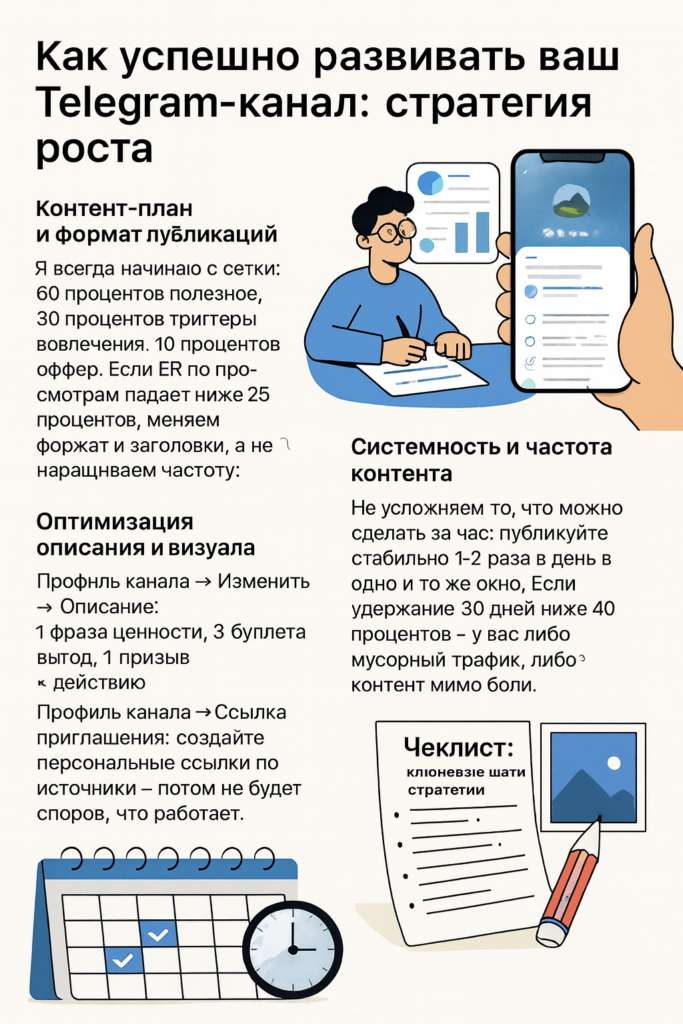
Now let’s go step-by-step, without chaos. Pick 2-3 content formats, set a rhythm, and create a checklist for your publishing rules. Pin a promo post with a clear offer and trust-builders to convert traffic in the first 24 hours. Set up UTM parameters for every traffic source, or your ad spend will disappear into a black hole. If you’re ready for discipline, you’re ready to grow.
I always start with a content grid: 60% valuable content, 30% engagement triggers, 10% direct offers. If your engagement rate by views drops below 25%, change your format and headlines—don’t just post more often.
Go to your channel profile → Edit → Description: one sentence on your value, 3 bullet points of benefits, and one call to action. For invite links: create unique links for each traffic source so you always know what’s working.
Don’t overcomplicate this: post consistently 1-2 times a day at the same time. If your 30-day retention is below 40%, you’re either getting low-quality traffic or your content isn’t addressing a real pain point.
To truly understand what’s behind that number, it’s important to break down how Telegram counts views: the difference between a first impression and a replay, how reposts are counted, and why “nice” numbers in your stats don’t always mean genuine interest.
Free methods work if you already have a converting profile and consistent content. This isn’t theory; it’s a working pattern: collaborations, cross-promotion, native placements in niche chats, and traffic from Instagram and YouTube. This is where most people give up—they forget about pinned posts and UTM tags, losing half the effect. First, clean up the clutter in your analytics, then draw conclusions. Want a 2-week free growth plan? Reach out, and I’ll send you a template.
Do cross-posts with channels similar in size and audience, not massive ones. Criteria: your partner’s 24-hour reach should be at least 20%, and audience overlap at least 60%.
Start with your own social media: Instagram, YouTube, TikTok—use stories, shorts, and pinned posts with a clear offer. Mini case study: a finance project I worked on went from 0 to 3,100 subscribers in 21 days using 8 Instagram Reels and 4 YouTube Shorts, with 52% 30-day retention.
If your channel has a community, add a chat and run one discussion per week on a high-pain topic. Path: Channel Profile → Discussion → Create a Chat, then enable the auto-link to the chat on every post.
| Tool | How to Use It | Expected Effect | Risks |
| Cross-posting | 1-to-1, same time slots, similar post length | 200-800 subscribers per round if partner’s ER is 25% | Audience mismatch, temporary spike with no retention |
| Guest posts | Provide expert content for a related channel with a byline and link | Warm traffic with high retention (45-60%) | Longer lead times, dependent on editor’s approval |
| Chats and comments | Add value with mini-case studies and UTM-tagged links | Steady flow of 10-50 subscribers per day | Reputation risk if you self-promote without adding value |
| Social media | Instagram stories, YouTube Shorts, TikTok clips with a clear CTA | Low-cost impressions, traffic spikes during posting | Low CTR without a strong offer and scarcity |
Paid channels are useful when you have a converting profile and a clear LTV. Advertising in other channels and blogs gives you quick scale; Telegram Ads works with interest and geo-targeting. Always track cost per subscriber and 30-day retention—without this, your budget will burn. If the numbers aren’t moving, it means you didn’t implement the fix; you just read about it. Need a media plan? Reach out.
Bots that sell fake engagement are a hard no—they’ll kill your reach and get you shadowbanned. Only use useful bots for automation: create one via BotFather, set up commands and integrations for your content and onboarding.
Pick platforms with transparent reach stats and at least 70% topic overlap. Criteria: the platform’s 24-hour reach should be 25-40% of its subscribers, and complaints should be below 0.1% of views.
To gauge how well these placements are performing, dive into How to see who viewed your Telegram post? This will help you use stats and indirect signals to distinguish genuine audience interest from bot-driven or accidental views, giving you a clearer picture of each platform’s true effectiveness.
For the US market, a reasonable range is $0.20–$0.80 per subscriber from channel ads, and $0.30–$1.20 from influencer placements. Telegram Ads can be $0.15–$0.60 with precise targeting. If it’s consistently higher, your creative or profile needs work.
| Channel | Cost per 100 Subscribers | Traffic Quality | When to Use |
| Channel ads | $20–$85 | Medium-High, 40-60% retention | You have an offer and pinned post, need fast scale |
| Influencers | $30–$120 | High if topic alignment is strong | You need social proof and loyalty |
| Telegram Ads | $15–$60 | Medium, depends on creative and targeting | Granular interest and language targeting needed |
| Cross-promo on own socials | $0–$12 | High, audience already knows you | At launch and for new content series |
Only scale what holds its metrics. Baseline thresholds: 24-hour reach at 25%, 30-day retention at 40%, link CTR at 3-7%. If metrics are lower, fix your content and offer first—don’t just throw more traffic at it. Use cohort reports by source to see the truth about where your money is going. Ready to cut weak sources? You’ll grow faster.
I track three key metrics: 24-hour View Rate, 7-30 day Retention, and CTR on your target link. If retention for a specific source is below 30%, that source isn’t right for you—cut it without hesitation.
Channel Profile → Statistics: get basic reach, source, and read-time data weekly. For ad links, use UTM tags and route them through a landing page to track in Google Analytics. Official docs: BotFather and Telegram Ads Help.
The biggest mistake: driving traffic before you have a solid profile and consistent content. Second: chasing subscriber count instead of retention and reach. Third: buying placements without UTM tags or asking for platform stats. Fourth: being inconsistent—the Telegram algorithm rewards stability. Let’s be real: either you do this, or you pay for it with lost reach.
A strategy without a single, focused metric will always drift. If your monthly goal isn’t expressed in numbers, you’re just scrolling through posts.
Long posts without a strong first paragraph kill your CTR. If the first two lines don’t address a problem, no one reads the rest.
Buying bots or fake engagement leads to lower reach and more complaints. Always vet platforms by their 24-hour reach and complaint history, or you’ll waste your budget.
Don’t look at likes, look at the numbers. Here’s a quick guide to cut through the myths. This isn’t theory; it’s a working pattern. Here’s how it should work: understand the term, tie it to an action. If something’s missing, reach out, and I’ll add it.
| Term | Definition | Critical Threshold | Action |
| 24-hour View Rate | The percentage of subscribers who saw a post within 24 hours | Below 25% | Change headlines and posting time |
| 30-day Retention | The percentage of users still active 30 days after subscribing | Below 40% | Revise content matrix and traffic sources |
| CTR | Clicks on a link divided by post views | Below 3% | A/B test first two lines and call to action |
| CPS (Cost Per Subscriber) | The cost to acquire one subscriber from a source | Higher than your LTV | Cut the source, test new creatives |
| UTM | Tags to track where your traffic comes from | Missing entirely | Add them to every link and keep a log |
The bottom line: successfully growing your Telegram channel isn’t about inspiration—it’s about a system of metrics and discipline. In my real-world cases, this approach delivers a 30-70% boost in reach within 6 weeks and lowers CPS by 20-35%. If you implement all the steps, growth will start in the first week. If the numbers aren’t moving, it means you didn’t implement the fix; you just read about it.

 Twitter / X
  LinkedIn
 Social media boosting
 Promotion
 Blog
Blog